
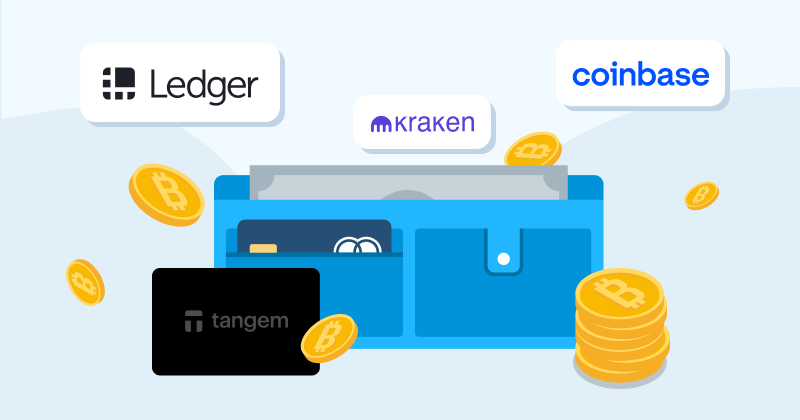
Wondering what the best cryptocurrency wallet for you is? In this guide, we'll break down the best software and hardware wallets for investors in 2026.
You can also use CoinLedger's Crypto Wallet Balance Checker to see the value of assets held in your wallet.
The tax deadline is almost here! Try CoinLedger to report your gains, losses, and income. You can generate a complete tax report in 30 minutes — no credit card needed until you download. Get started with a free account today.
The best crypto wallets

Coinbase Wallet is one of the most trusted self-custody wallets available, offering a seamless experience for beginners while supporting advanced features like NFTs, DeFi protocols, and dApps. Unlike the Coinbase exchange, this wallet puts you in control of your private keys.
- Currently only supports 10+ blockchains — less than some competitors.
- Some investors prefer wallets not associated with centralized exchanges.

Tangem is a unique card-shaped hardware wallet using NFC technology. It supports 16,000+ cryptocurrencies and offers exceptional security — private keys are generated and stored directly on the card chip itself. Optional seed phrase eliminates the risk of loss.
- Requires an NFC-enabled smartphone — no desktop support.

MetaMask is the world's most popular Ethereum wallet with over 30 million users. It's the go-to wallet for DeFi protocols, NFT marketplaces, and dApps. Available as a browser extension and mobile app, it supports Ethereum and all Layer 2 networks.
- No plans to support non-EVM chains like Bitcoin or Cardano.

Phantom is the leading wallet for the Solana ecosystem, known for its beautiful interface and strong NFT support. It has since expanded to Ethereum and Polygon, offering a seamless multi-chain experience with built-in swaps.
- Some users report token value display issues during high volatility.
- Ethereum and Polygon features less developed than Solana.

Rabby is a powerful multi-chain wallet with transaction previews that show exactly what will happen before you sign. Built by the DeBank team with automatic chain switching and excellent DeFi portfolio tracking.
- Does not support staking. Relatively new — less battle-tested than MetaMask.
- Mobile app can be slow.

Guarda Wallet supports 50+ blockchains with built-in staking, buying, and exchange features. Available across all platforms — web, desktop, mobile, and browser extension — making it highly accessible for all users.
- Fiat-to-crypto purchase fees can be as high as 2%.

Crypto.com Onchain is a self-custody wallet that integrates with the Crypto.com ecosystem. It supports DeFi, staking, and NFT storage with a clean mobile interface. A solid choice for users already invested in the Crypto.com platform.
- Some investors avoid wallets created by centralized exchanges.
- Charges a 0.05% service fee on staking rewards.

Trust Wallet supports over 100 blockchains and includes a built-in Web3 browser for dApps, a native DEX, and an NFT gallery. One of the most widely-used mobile crypto wallets globally, acquired by Binance in 2018.
- Does not support two-factor authentication via authenticator app.
- Associated with a centralized exchange (Binance).

Exodus is a beautifully designed wallet with a stunning portfolio dashboard and built-in exchange. Available on desktop and mobile, it offers great UX for everyday crypto management and supports Ledger hardware wallet integration.
- Closed-source software — cannot be independently audited.
- Does not support two-factor authentication.
ZenGo is an innovative keyless wallet that eliminates the seed phrase using multi-party computation (MPC) cryptography and biometric authentication. Virtually impossible to hack, and you never risk losing access due to a lost seed phrase.
- Transfers can be slower than other wallets.
- Best security features require a paid subscription.
- Supports fewer blockchains than competitors.
Hardware wallets
Hardware wallets (cold wallets) store your private keys completely offline on a physical device — immune to online hacking. Considered the gold standard for cryptocurrency security.

Ledger is the world's best-selling hardware wallet, trusted by over 6 million users. The Nano series offers unparalleled security via a certified secure element chip, connecting to Ledger Live for portfolio management, staking, and buying crypto.
- Ledger operates on closed-source software.
Trezor was the world's first hardware wallet and remains a top choice for users who value open-source transparency. Firmware is fully open-source for independent audits. The Model T adds a touchscreen, and the Safe 5 features a colour display.
- Plastic body feels less premium than some competitors.
- Security researchers have claimed physical hack vulnerabilities in the past.
Quick comparison table
| Wallet | Type | Price | Supported Cryptos | Rating |
|---|---|---|---|---|
| Coinbase Wallet | Software | Free | 1,000+ | ⭐ 4.8 |
| Tangem | Hardware | $54.90+ | 16,000+ | ⭐ 4.8 |
| MetaMask | Software | Free | ERC-20 + L2 | ⭐ 4.8 |
| Phantom | Software | Free | SOL, ETH, MATIC | ⭐ 4.5 |
| Rabby Wallet | Software | Free | 40+ blockchains | ⭐ 4.4 |
| Guarda | Software | Free | 50+ blockchains | ⭐ 4.2 |
| Crypto.com Onchain | Software | Free | 30+ blockchains | ⭐ 4.2 |
| Trust Wallet | Software | Free | 100+ blockchains | ⭐ 4.2 |
| Exodus | Software | Free | 250+ cryptos | ⭐ 3.9 |
| ZenGo | Software | Free* | 10 blockchains | ⭐ 4.1 |
| Ledger | Hardware | $79+ | 5,000+ | ⭐ 4.8 |
| Trezor | Hardware | $49+ | 1,000+ | ⭐ 4.2 |
What is a crypto wallet?
Cryptocurrency wallets are applications (or physical devices) that allow you to securely store, send, and receive cryptocurrencies. Despite the name, a crypto wallet doesn't store your crypto — your coins always remain on the blockchain.
What a wallet stores are your private keys — the cryptographic codes proving ownership and allowing you to authorize transactions.
Public keys are like your bank account number — share freely to receive crypto. Private keys are like your PIN — never share them with anyone.
Why do I need a custodial wallet?
Many cryptocurrency advocates use the phrase "Not your keys, not your crypto." This essentially means that if your cryptocurrency is stored on an exchange, you are not the true owner of the crypto.
While cryptocurrency exchanges offer a convenient way to trade and store cryptocurrency holdings, you may lose access to your crypto if your account is frozen, the security of the exchange is breached, or the exchange goes bankrupt.
In recent years, crypto investors have lost access to their holdings after exchanges like BlockFi and Voyager filed for bankruptcy. A self-custody wallet eliminates this counterparty risk entirely.
How does a crypto wallet work?
A cryptocurrency wallet helps you store and manage your cryptocurrency. It has two key parts: public keys and private keys.
- Public keys: Similar to bank account numbers — they show your cryptocurrency balance without compromising the security of your account.
- Private keys: Like the password to your bank account. They allow the wallet owner to access their cryptocurrency and sign off on transactions.
Most wallets generate a seed phrase (12–24 random words) — a master backup of your private keys. Store it offline, never digitally, and never share it with anyone.
What type of wallet should I choose?
Not sure what type of wallet is right for you? Let's walk through the differences between hot and cold wallets.
Connected to the internet. Convenient for frequent trading and DeFi. Examples: MetaMask, Coinbase Wallet, Trust Wallet.
- ✓ Free to use, always accessible
- ✓ Great for DeFi & NFTs
- ✗ Higher security risk (online)
Stores keys completely offline. Maximum security for long-term holding. Examples: Ledger, Trezor, Tangem.
- ✓ Maximum security
- ✓ Immune to online attacks
- ✗ Costs $49–$200+
Many experienced investors use both: a hot wallet for daily DeFi activity and a hardware wallet for long-term storage.
What to consider when choosing a wallet
- Reputation: Choose wallets with proven security records and large user bases.
- Purpose: A hot wallet like MetaMask may be a good fit if you're looking to experiment with DeFi, while a cold wallet is better for long-term holding.
- Blockchains supported: Make sure the wallet supports your cryptocurrencies.
- Security features: Look for 2FA, multi-sig support, and biometric login options.
- Open-source vs. closed-source: Open-source wallets can be independently audited.
How do I keep my crypto wallet safe?
'Phishing' is a common scam — hackers use fake websites or messages to steal your seed phrase. Never enter your seed phrase on any website.
- Store seed phrase offline: Write it on paper and keep it in a safe, waterproof location. Never store it on an Internet-connected device.
- Enable 2FA: Use an authenticator app (not SMS) for exchange accounts.
- Use a hardware wallet for large amounts: For holdings above $1,000, consider getting started with a Ledger or Trezor.
- Verify transaction approvals: Check exactly what permissions you're granting before signing any transaction.
- Keep your software updated: Always use the latest version for security patches.
How do I track the value of my crypto across different wallets?
If you're like most crypto investors, you're likely using multiple wallets and exchanges. Unfortunately, this can make tracking the total value of your holdings difficult — as you'll need to flip between multiple platforms.
That's where a crypto portfolio tracker can help. CoinLedger connects to hundreds of wallets and exchanges — giving you a real-time look at your crypto portfolio!
Connect your wallets automatically to see your complete portfolio in real-time.